

Why Being a Generalist Is the Future of Work (and How to Thrive Without a Niche)
Ever since I can remember, I was pushed — gently, but firmly — toward “doing something important.” Go to university. Become someone. And because I naturally liked helping people, medicine made sense. For a while, I even toyed with becoming a criminal profiler (too many TV shows, I know). But medicine remained the big, serious plan.
Toward the end of high school, reality came fast. I loved biology — especially genetics — and knew that was my direction. But the idea of being a doctor started to terrify me. Not because I didn’t think I could handle it, but because I feared I’d be… average. Mediocre. And in medicine, mediocrity feels dangerous.
This article isn’t just research. It’s a personal compass. If you’ve ever felt guilty for shifting direction, or worried that exploring new paths means disrespecting the old ones — this is for you.
My closest friends were all preparing for med school. We used to dream about each becoming doctors, each in our own specialty. I wanted surgery — something with blood, something intense, something that mattered. But deep down, I knew I was hesitant. Not because I couldn’t do it, but because I couldn’t see myself doing just one thing for the rest of my life.
Medicine doesn’t leave much room to shift. Six years of school. Then years of specialization. Then, ideally, you pick a niche — pediatrics, surgery, cardiology — and you stay there. Forever. And what if I changed my mind? What if I realized too late that I wanted something else? I already knew I’d want something else.
So I made a decision. A practical, honest, self-preserving decision. I still went into medicine — but I chose to become a generalist medical assistant. It wasn’t as glamorous, not as high in status or salary, but it came with something more important to me: freedom.
So I stepped into the role of a generalist medical assistant — a path that gave me structure, meaning, and just enough room to breathe. I was part of something bigger. I was helping people. I was needed.
But over time, that same clarity started to feel… restrictive. The routines. The repetition. The way your days begin to blur together, even when you’re doing important work. I began to feel a quiet restlessness. A hum beneath the surface.
It wasn’t sudden. It never is. But one day, I noticed I was staying up late to sketch design ideas. Watching YouTube tutorials on Excel formulas. Learning about interior spaces, herbal remedies, and mental health—not because I had to, but because I wanted to. These weren’t hobbies. They were breadcrumbs.
Then motherhood happened — not planned, not tidy, but exactly on time. It wasn’t a reinvention arc; it was a pause. And in that chaos, I finally had permission to ask better questions — and space to hear the answers.
Embracing Generalism: Why Being a Jack-of-All-Trades Can Be a Superpower 🌟
Are you curious about everything? In a world that still loudly rewards specialization, generalists often go unnoticed—or worse, taken for granted. They’re the ones who end up doing a little bit of everything, because they can, and because people around them start expecting it. Over time, that flexibility can become invisible labor.
And yet, those same skills—adaptability, quick learning, cross-domain thinking—are exactly what companies now seek. Why? Because hiring one person who can handle three roles looks efficient on paper. (Spoiler: it’s not, unless they’re also paid triple.)
Sorry, I needed to rant a little. 😅
This article explores the science, challenges, benefits, and emotional freedom behind embracing generalism—as a mindset, not just a skill set.
📜 A Brief History of Generalism
The word “generalist” might feel modern, but the concept is ancient. Think of Renaissance figures like Leonardo da Vinci, who effortlessly blended art, science, engineering, and anatomy. In that era, being skilled in multiple disciplines wasn’t seen as confusion—it was genius.
Fast-forward to today, and the tides are turning back. The 20th century prized hyper-specialization, but in the 21st, adaptability is key. The digital age favors those who can transfer skills across domains, think laterally, and learn on the go.
So no, you’re not “late” to anything. If anything, you’re right on time—just like the generalists before you.
The Myth of “One Career for Life” 🔎
From an early age, we’re asked: “What do you want to be when you grow up?” The question itself suggests a singular answer—a single profession we’ll presumably commit to forever. Yet modern research into career development shows that many individuals will change careers at least a few times in their lives, adapting to new opportunities or shifting personal interests.
According to a 2020 HBR report by Rob Cross and Greg Pryor, high performers in dynamic companies often exhibit broad networks and cross-domain fluency—classic generalist traits.
In a rapidly evolving world, technology disrupts industries, and new fields emerge almost overnight. It’s becoming increasingly clear that being nimble can be more advantageous than sticking rigidly to a single path. Generalists often find themselves more adaptable in the face of economic or technological change.
The Science Behind Curiosity and Breadth 🧠
Curiosity is a fundamental human drive—some psychologists even refer to it as a core component of intrinsic motivation. A paper published in the Journal of Research in Personality noted that individuals with high levels of curiosity are more likely to explore novel experiences, pick up new skills, and bounce between interests. This doesn’t mean they lack discipline; rather, they’re energized by the thrill of discovery.
Interestingly, neuroimaging studies suggest that when we learn something new, our brain’s reward system lights up. This dopamine-driven “reward” encourages us to repeat behaviors that brought us pleasure—explaining why you might feel compelled to dive into different topics over time. Embracing a breadth of knowledge can thus be a way to continually engage the brain’s learning circuits.

How Generalists Learn (and Keep Learning)
Barbara Oakley, creator of the famous Learning How to Learn course, explains that people who cross disciplines often build deeper understanding through analogies and metaphor. This makes their learning stickier—and their insights more creative. Generalists aren’t just dabbling; they’re absorbing from multiple angles.
Generalists vs. Specialists: Do We Really Need Both? ⚖️
Yes. Unequivocally. Specialists dive deep and push boundaries within a specific field — they’re the surgeons, quantum physicists, and structural engineers of the world. But generalists? They connect the dots others don’t even see.
Here’s how the two stack up:
🧠 Generalists
- Thrive across disciplines, blending skills from multiple fields
- Pivot easily when industries shift or jobs disappear
- Bring systems thinking — they see how things interconnect
- Ideal for strategy, innovation, leadership, or any role that requires wearing more than one hat
🔬 Specialists
- Go deep in one domain and become authorities in their niche
- Excel in stable environments that reward precision and repetition
- Critical for highly technical work (medicine, engineering, academia)
- Ideal for research, mastery, and roles that demand focused expertise
➡️ The truth? You need both on any strong team. Specialists build the ship. Generalists navigate new waters.
In his book Range: Why Generalists Triumph in a Specialized World, David Epstein argues that in complex or rapidly changing environments, breadth of experience can yield innovative solutions. Specialists might perfect existing processes, but generalists often create new approaches by merging perspectives.
Epstein’s research highlights how generalists often outperform early specialists in unpredictable fields—precisely because they’ve trained themselves to think laterally, not linearly. His work is a must-read if you’ve ever felt “behind” for not picking one path early.
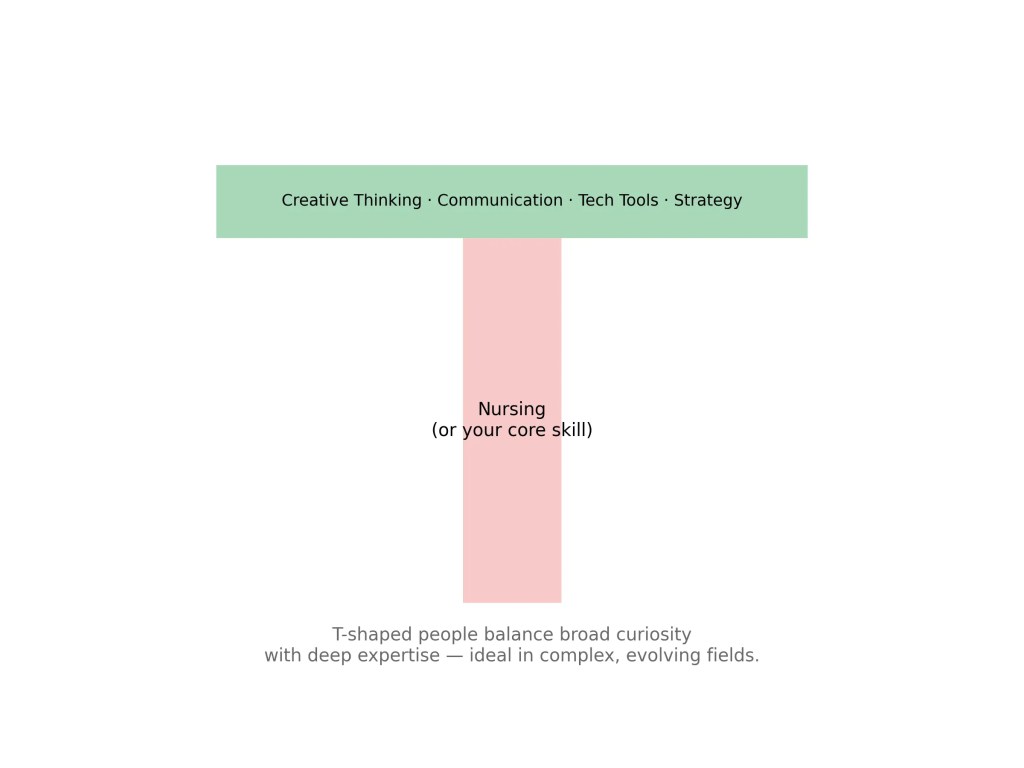
What Is a T-Shaped Person?
A T-shaped person combines broad knowledge across many areas (the top of the “T”) with deep expertise in one specific domain (the vertical line).
For example, you might be trained in nursing, but also explore blogging, herbal medicine, data tools, design, or psychology.
This balance is a secret weapon in today’s world.
Employers love it because it brings adaptability without sacrificing depth. Teams love it because it bridges silos. And generalists love it because it lets them roam without drifting.
You’re not scattered. You’re just a capital T in a world that keeps trying to force you into lowercase i’s.
T-shaped thinkers thrive by cross-pollinating knowledge. They zoom out, connect dots, and still know how to go deep when it matters.
Together, these traits can enrich your journey as a curious, ever-evolving learner — not despite your variety, but because of it.
Why T-Shaped People Are In Demand
More and more employers — especially in creative, tech, and education fields — are actively seeking T-shaped professionals:
- ✅ Broad knowledge in multiple domains (creativity, soft skills, tools)
- ✅ Deep knowledge in at least one area (ex: medical, design, analysis)
- ✅ Strong collaboration across disciplines
- ✅ Ability to see both detail and big-picture
- ✅ Flexible enough to adapt in AI-driven or remote work environments
This shape is especially helpful in product teams, startups, marketing, UX, and even modern education. It balances depth with curiosity.
Specialization Happens Naturally 🌱
One major misconception is that if you don’t intentionally specialize, you’ll remain a novice forever. In reality, repetition plus time = expertise. You might find yourself returning to certain areas repeatedly, slowly building skill and proficiency without feeling locked into a single identity.
Example: If you gravitate towards data analysis in multiple jobs, you’ll become more advanced in that skill set—even if you also dabble in project management, creative writing, or languages.
Career Fluidity: Embracing generalism doesn’t mean avoiding depth; it means allowing depth to develop organically where your passion naturally flows.

Moreover, many organizations are increasingly seeking “T-shaped” professionals—people with broad knowledge in several areas (the top of the ‘T’) and deeper expertise in at least one domain (the vertical part of the ‘T’). This blend of breadth and depth can be a significant advantage in interdisciplinary teams.
The Emotional Relief of Accepting You’re a Generalist
Feeling trapped is a key complaint among those who try to confine themselves to a single profession or niche. Generalists often experience a sense of liberation by exploring multiple interests:
- Reduced Burnout: Switching focus periodically can be refreshing, preventing monotony and mental fatigue.
- Constant Inspiration: Cross-disciplinary exploration often sparks fresh insights. A marketing idea might come from studying psychology, while a solution to a coding problem might pop up after reading about biology.
Additionally, generalists frequently report that they don’t feel pressured to be “the best” in one field. Instead, they take genuine pleasure in learning for learning’s sake, which can sustain long-term motivation and mental health.
Wait… Is This Just Undiagnosed ADHD with a Canva Subscription?
Okay, maybe not always. But here’s the thing: generalists and people with ADHD often share traits—like racing curiosity, nonlinear thinking, and a tendency to jump between interests. That doesn’t mean every generalist is neurodivergent, of course. But the overlap is fascinating.
Many generalists describe a sense of internal urgency: if something feels boring, it’s physically hard to stay engaged. Novelty becomes a need, not a luxury. And yes, sometimes that means 12 open tabs, 4 unfinished projects, and a strong belief that “this next one will be The One.”
So if you’ve ever felt like your brain is sprinting while the world strolls… you’re not broken. You’re probably just wired for variety. And you’re in good company.
(And no — this isn’t a diagnosis. But if any of this sounds eerily familiar, it might be worth exploring with someone qualified.)
🧩 Debunking the Myths: Most People Are Generalists (and That’s Not an Insult)
“Jack-of-All-Trades, Master of None”: This phrase is incomplete. The full version reportedly ends with “…but oftentimes better than master of one.” That part never makes it to LinkedIn posts, huh?
“Generalists Are Indecisive”: Actually, many generalists are hyper-decisive in the short term—they know how to pick a project and commit. They just don’t want to pick only one thing forever.
“Generalists Lack Commitment”: Let’s reframe that. Committing to ongoing learning across multiple areas is still commitment—it just doesn’t come with a job title.
And here’s the thing nobody says out loud: most people are generalists by necessity or design. The bell curve exists for a reason. Not everyone is a savant, a thought leader, or a disruptor. But most of us are curious, capable, and cobbling together meaning from different sources. That’s not weakness. That’s life.
Extreme specialization often requires rare traits (high IQ, obsessive focus, hyper-specific interest). The rest of us? We learn what we need, wear multiple hats, and make it work. We adapt. We stretch. We survive.
Generalism doesn’t mean drifting. It means building horizontal depth—knowledge across domains, not in spite of curiosity, but because of it.
So if someone calls you a jack-of-all-trades, feel free to reply:
“Yup. And I’m still better than your one-trick pony.”
Let’s be honest — neither generalism nor specialization are things you sit down and plan out like a five-year strategy. They just… happen. As you live, as you adapt, as life pushes and pulls you. It’s only now, because we’re obsessed with evolving faster, naming things, optimizing identity — that we start to overthink what used to just be… living. Nothing fancy. Just life.
What actually happens? You follow the script. School, job, repeat. You stay in a career because it’s safe or expected, not because you’re thrilled. And then, somewhere between your third performance review and your fifteenth reheated lunch, it hits you: a whisper, a buzzing, a persistent itch for something else.
That feeling? Totally normal. It’s not a bug. It’s how we’re wired. But in today’s hyper-speed culture — where everything has to be labeled, monetized, and optimized — we don’t give that feeling room to breathe.
A century ago, identity shifts happened gradually. People moved from farms to factories to offices over decades. Boredom was a season, not a crisis. Now? We expect transformation overnight. And when that doesn’t happen, we panic.
Some people respond with curiosity: they try new hobbies, take random courses, rearrange their entire house. Others go for full-blown reinvention. And unfortunately, sometimes that means burning bridges — careers, friendships, even families — not because they’re broken, but because we misread restlessness as a red flag.
Of course, not every woman who leaves a long-term relationship is having a midlife identity crisis triggered by boredom and burnout. Some situations are complex, painful, and deeply valid. (And yes — boredom and burnout can show up in other areas of life too, not just in careers. Relationships, routines, even parenting — anything repetitive for too long can quietly wear us down.)
But let’s not pretend we haven’t also seen the other side — the performative “reinvention” spirals that leave a trail of broken families and vague captions about “growth.”
You know the type. You know the story.
“She’s 39, a mom of three, married for fifteen years. Then one day, she says she needs to “find herself.” Leaves her husband and kids to start fresh with some guy ten years younger who “gets her.” Two months later? He ghosts her.
Now she’s back online with soft filters and long captions about “healing” and “missing Sunday dinners.”
And she’s not the only one.
People confuse burnout or boredom with being “unfulfilled,” and instead of recalibrating, they blow up everything they built. Spouses leave each other. Parents ghost their families. Friendships vanish. All in the name of some half-formed, influencer-fueled idea of authenticity.
But here’s the truth: sometimes you’re not unfulfilled. You’re just tired. Overstimulated. Dehydrated. Maybe you need less drama and more vitamin D.
If you’re craving change, good. That means your system still works. But change doesn’t always mean destruction. It can mean reorientation. A course-correct. A fresh page—not a scorched earth.
So no, you’re not lost.
You’re evolving.
But slowly. Naturally. Like humans are meant to.
Stop trying to speed-run a personality reboot. You’re not software. You’re soil. Give yourself seasons. Most of your crisis isn’t about purpose. It’s about overstimulation, chronic decision fatigue, and skipping breakfast. Start there.
The Generalist Path to Recovery🔥🧯
Not all generalism begins with curiosity or creativity. For many of us, it began with burnout.
When life became too narrow, too repetitive, too suffocating — we didn’t set out to become multifaceted professionals. We were just trying to feel alive again. Generalism wasn’t a career strategy. It was a recovery instinct.
Burnout doesn’t just make you tired. It strips you of identity. Of confidence. Of joy. And in the aftermath, you grab for anything that feels different: cooking, painting, spreadsheets, psychology, poetry. Not because you have a vision — but because you’re trying to remember who you are.
And here’s the twist: over time, those scattered coping mechanisms start to form a pattern. You build skills, explore directions, follow instincts — and suddenly, you’ve built something real.
But because it started from pain, we often mislabel it. We see it as avoidance. Dabbling. Indecision. A lack of commitment.
When really? It was healing. It was adaptive. It was your brain saying: let’s try something else.
Generalism doesn’t always come from ambition. Sometimes it comes from being broken — and putting yourself back together in chapters.
And there’s no shame in that — or in how you got here either.
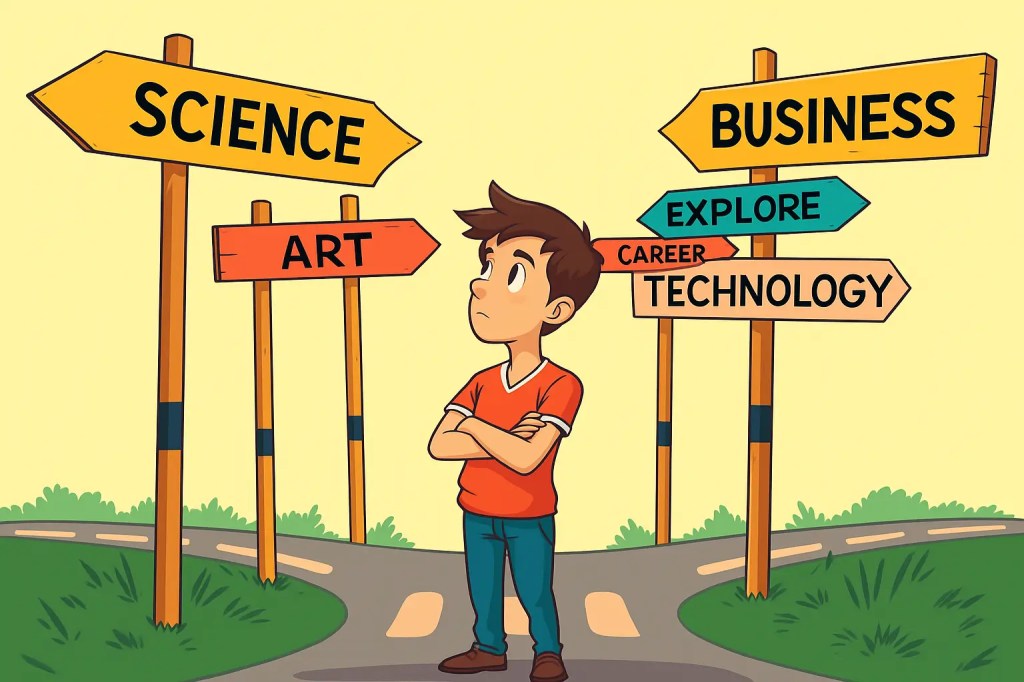
What Holds You Back from Becoming a Generalist? 🚧
1. Social Expectations
- Cultural Pressure: Many cultures reward clear professional identities—engineer, doctor, lawyer—which can make the “jack-of-all-trades” label seem less prestigious. You might fear judgment from family or peers if you don’t pick one domain.
- Job Market Stereotypes: Some recruiters look for narrowly defined skill sets. This perception can discourage aspiring generalists who worry that they won’t “fit” a traditional job description.
2. Fear of Inadequacy
- Imposter Syndrome: If you’re always learning something new, you might feel like a beginner in multiple areas, questioning whether you’re truly “good enough” at any of them.
- Perfectionism: People who need to excel at every task might avoid branching out, fearing they won’t meet high standards across multiple fields. Psychological research points to perfectionism as a significant barrier to trying new things.
3. Lack of Clear Role Models
- Few Generalist Champions: We see specialists—like elite athletes or celebrated scientists—featured prominently in the media. Generalists tend to work behind the scenes or have non-linear success stories that aren’t always highlighted.
- Limited Mentorship: It can be challenging to find mentors who encourage broad exploration. Many mentors push for depth in a single domain, making it hard for budding generalists to see a viable path.
How to Start Embracing Generalism 🌱

1. Adopt a ‘Beginner’s Mindset’
- Curiosity-Driven Learning: Pick one new skill that excites you—maybe photography, creative writing, or coding. Spend a few weeks exploring it, accepting that you don’t have to master it immediately.
- Safe-to-Fail Experiments: Psychological studies indicate that experimenting in low-stakes environments helps you learn faster and more enjoyably. Give yourself permission to fail, knowing each attempt deepens your perspective.
2. Create a Rotating Schedule
- Segment Your Week: Dedicate certain days or hours to different interests (e.g., Monday for language learning, Wednesday for design). This structure ensures variety without becoming overwhelming.
- Set Small Milestones: Break each new field into small goals—like completing a beginner tutorial or finishing a short project. Celebrate each achievement to keep motivation high.
3. Build Your ‘Support and Skill’ Network
- Seek Like-Minded Explorers: Join communities (online or offline) where others share multiple interests. Here, you’ll find encouragement to keep exploring.
- Connect with Specialists: Maintain friendships or professional contacts with experts. Their depth complements your breadth; collaboration can spark innovative ideas.
4. Document and Reflect
- Skill Tracking: Keep a journal or digital portfolio of what you’ve learned in each field. This helps you see your progress and identify unexpected connections.
- Self-Evaluation: Every few months, assess what you’ve enjoyed learning most. Which fields do you gravitate toward naturally? This can guide future exploration and might reveal hidden niches where depth feels more organic.
5. Embrace the Growth Mindset
- Progress Over Perfection: Stanford psychologist Carol Dweck’s work on growth mindset highlights the importance of viewing skills and intelligence as expandable. By seeing yourself as a lifelong learner, you stay open to continuous exploration.
- Celebrate the Process: Instead of fixating on outcomes (like awards or titles), value the journey. Each field you dabble in expands your mental toolkit and shapes your unique perspective.
The AI Era Needs Generalists
According to WIRED and Harvard Business Review, industries are shifting toward hybrid roles that combine human insight with technical fluency. Generalists — or what some call “Swiss Army Knife” professionals — are ideal in these dynamic settings.
Whether you’re moving into content, entrepreneurship, consulting, or tech, your ability to connect dots across domains is what sets you apart.
Generalist vs Specialist: Which Path Fits You Best?
In a world of increasing complexity and automation, both specialists and generalists have important roles. But many people today are asking: Which is better in the long run?
Generalists:
- Thrive in startups and small teams where multiple roles overlap
- Naturally grow into leadership or strategy roles due to cross-functional understanding
- Can adapt faster to new technologies or job disruptions
- Risk: burnout or feeling scattered — but time-blocking and clear goals help balance
Specialists:
- Excel in deep technical fields: medicine, engineering, research
- Build strong professional identity and authority in one domain
- Risk: struggle to pivot when their field is disrupted
The truth? Most high-functioning teams need both — and being aware of your style helps you lean into your strengths.
🍫 Bonus Reading, Because We’re Never Just One Thing:
If this article lit a small fire of curiosity, here are three more reads that speak to your multifaceted self:
- Burnout but make it subtle? Read: Recognizing the Hidden Signs: How Emotional Neglect Stealthily Leads to Burnout
- Need to sweeten the existential crisis? Try: Easy Homemade Chocolate Recipe – Just Like in Childhood!
- Small steps, big shifts? You’ll love: 10 Small Habits for a Better, Simpler Life
Because generalists know: growth needs fuel, flavor, and… a little chocolate.
So, if you’ve ever felt…
- like you’re doing too many things and none of them “matter,”
- like your curiosity is a liability instead of a strength,
- like you’re broken because you couldn’t choose just one path,
- or like your burnout led you to unexpected passions —
…then maybe you’re not lost. You’re just a generalist in a world that hasn’t learned to value you properly.
Keep going. Keep exploring. You’re not behind — you’re just built differently.
(And if this whole piece felt like a bit of a rant… it kind of was. But hey — at least I’m not selling you a course at the end. Just a quiet little newsletter. No pressure.)

🌿 Evolve & Thrive with Lela #SimplifyWithLela 🌿
 MakeItSimpl3