
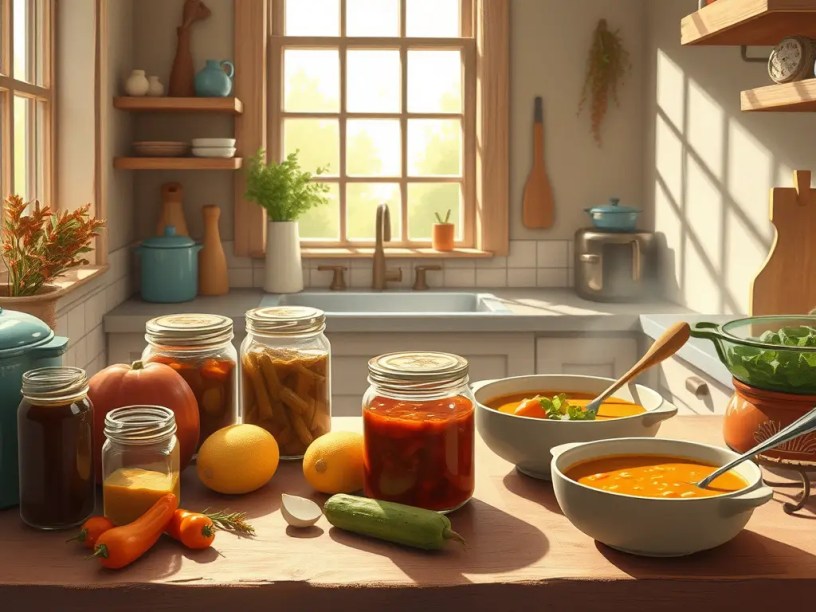
🍲 Cooking as Daily Support
I cook because it works.
I cook because it keeps daily life stable and predictable — and because it gives me a routine that rarely changes.
This is one of the few rhythms I fully control. Even when everything else feels chaotic, this doesn’t. The meals are familiar, the process is known, and that consistency acts as an anchor. It steadies the day.
Cooking this way removes a constant source of stress — deciding what to eat, running to the store, improvising when energy is already low. When food has a rhythm, it becomes support instead of pressure.
It’s about making life easier — and better.
🧱 What This Kitchen Is (and Isn’t)
What this kitchen is:
- Seasonal food, chosen because it’s available and makes sense
- Ingredients you can actually find — not hunt for
- Recipes that adapt to energy levels, not just skill levels
- Flavor over perfection, always
What this kitchen is not:
- Diet culture wearing a softer outfit
- Superfoods that only exist online
- Sterile aesthetics that ignore real use
- Food as discipline, identity, or virtue
Seasonal cooking here isn’t about having time, skills, or a perfect kitchen.
It’s about working with what’s available — ingredients, energy, and appetite — right where you are.
Whether you cook in a quiet home or a crowded apartment, real food adapts to real life. It always has.
💛 Why Familiar Food Matters
Familiar food does something trends never will: it stabilizes you.
It’s the dish you return to when everything feels noisy.
The flavor that reminds your body it’s safe.
For me, cooking is also deeply practical. I cook often because I enjoy it and because I have people to cook for — but I don’t need to cook every day. Two or three cooking sessions a week are usually enough to keep real food in the house at all times.
Over time, I’ve learned that food doesn’t need constant novelty. Our meals, seen from the outside, might even look boring: a soup, a stew, maybe pasta, a couple of simple sides, and something sweet once in a while. The base recipes stay the same. What changes is usually the meat, the vegetables, or the season.
This kind of repetition isn’t limitation — it’s relief.
Because the foundation is prepared ahead of time, mostly in autumn: jars of soup vegetables, tomato sauce, pickles, compotes, frozen fruit. Meat we know we like is portioned, frozen, or cured in advance. By winter and spring, most of the work is already done.
In summer and early autumn, it gets even simpler. Fresh produce, eaten as it is. Less cooking, fewer steps, one weekly soup at most. Food follows availability instead of fighting it.
Knowing how to cook from a few basic ingredients — and knowing that you can — removes a quiet but heavy fear: that you might somehow be left without food. It builds a calm confidence: I know how to feed myself. I will be fine.
That sense of control matters more than people admit. It supports self-esteem. It lowers anxiety. Food becomes nourishment, not a coping mechanism.
And when everything is seasonal, it becomes special again. Cherries belong to June — intensely, joyfully, almost excessively. Tomatoes arrive late summer and early autumn, and that’s when they matter. When they’re gone, they’re gone. You wait. You look forward to them.
Preserved versions help, but they don’t replace the real thing — and that’s exactly the point. Seasonality teaches appreciation.
Cooking and preserving meet here: one feeds the present, the other supports the future. Both adapt to real life, not the other way around.
The same goes for holiday food. Because everyday meals are simple and familiar, holiday dishes stand out naturally. They’re cooked less often, with more care, and received with more attention. Not because they’re extravagant, but because they mark time — a pause, a gathering, a moment worth noticing.
That predictability also makes room for curiosity. When the kitchen is easy and familiar most of the time, it’s much simpler — and more enjoyable — to occasionally try something new. A weekend recipe, a dish you’ve been thinking about, something a bit more involved. Not as pressure, but as play. Because it’s optional, it stays interesting.
Taken together, this rhythm — simple daily meals, seasonal waiting, and occasional celebration — turns food into something steady enough to rely on, and flexible enough to enjoy.
📋 How This Category Works
Inside this category, you’ll find:
- Simple, everyday recipes
- Seasonal adaptations of familiar foods
- Traditions explained without pressure
- Variants that respect real kitchens
These recipes are meant to be used, adjusted, repeated, and sometimes ignored until you need them again.
They’re written for real kitchens — the kind where food needs to be ready, eaten, and relied on.
🔁 Cooking as Continuity
Cooking here isn’t about improvement or ambition. It’s about steadiness.
About knowing that, no matter how the day goes, there will be food you recognize and trust. About having one part of daily life that doesn’t need rethinking, reinventing, or constant attention.
When cooking follows a simple rhythm — familiar meals, seasonal shifts, occasional effort — it stops being a source of stress. It becomes something that quietly supports everything else.
That’s the role of food here: not to impress, not to optimize, but to hold.
💛 Make it seasonal. Make it reliable. Make it yours. #SimplifyWithLela 💛
 MakeItSimpl3